Data Structure and Dart Programming language problems

  • Home
  • Data Structure
    • Array and String
    • Linklist
  • Google Flutter
    • Google Flutter
    • DART
  • About Us
  • Home
  • Data Structure
    • Array and String
    • Linklist
  • Google Flutter
    • Google Flutter
    • DART
  • About Us
Showing posts with label java. Show all posts

Tuesday, March 21, 2017

Compare two linked lists

 Tech host     9:47 AM     compare-two-linked-list, frequently-asked-question, interview-question, java, linklist-interview-question, linklist-question, popular-linklist-question     No comments   

Linked list Interview Question

linklist

Compare two linked lists

compare-two-linked-list

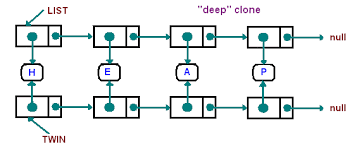
You’re given the pointer to the head nodes of two linked lists. Compare the data in the nodes of the linked lists to check if they are equal. The lists are equal only if they have the same number of nodes and corresponding nodes contain the same data. Either head pointer given may be null meaning that the corresponding list is empty.

Input Format

You have to complete the int CompareLists(Node* headA, Node* headB) method which takes two arguments - the heads of the two linked lists to compare. You should NOT read any input from stdin/console.


Output Format
Compare the two linked lists and return 1 if the lists are equal. Otherwise, return 0. Do NOT print anything to stdout/console.

Sample Input

NULL, 1 --> NULL
1 --> 2 --> NULL, 1 --> 2 --> NULL

Sample Output

0
1
Explanation 
1. We compare an empty list with a list containing 1. They don't match, hence return 0. 
2. We have 2 similar lists. Hence return 1.

int CompareLists(Node *headA, Node* headB)
{
    int flag=0;
  // This is a "method-only" submission. 
  // You only need to complete this method 
    while(headA!=NULL)
        {
        if(headA->data==headB->data)
            {
            flag=1;
        }
        else
            {
            flag=0;
            break;
        }
        headA=headA->next;
        headB=headB->next;
    }
    if(headB!=NULL)
        {
        flag=0;
    }
    return flag;
}
Note that this approach is not only specific to this type of question you can use this sorting technique in various questions such as if you want to check whether to word are anagrams of one another or not. You can simply sort them and compare them to find out. This approach is also helpful in other questions so i suggest that its better to learn this tricks and keep in mind while attempting the question you may find it useful. You can always search for more coding problems like this to get comfortable to this to approach or you can find new problems where this approach is applicable. So go and search more problems like this and check whether this approach is useful or not and you can tell me about it by commenting and writing about this to me.

Try more and more problems that you find on string and arrays and try to develop an approach the will help you understand problems rather then learning the solution. Once you know how to approach the problem you will able to solve any problem related to strings and array. I wish best of luck to you for your future.
Read More
  • Share This:  
  •  Facebook
  •  Twitter
  •  Google+
  •  Stumble
  •  Digg

Wednesday, March 15, 2017

Reverse of a given linked list

 Tech host     9:25 AM     cracking-the-coding-interview, frequently-asked-question, interview-question, java, linklist-interview-question, linklist-question, popular-linklist-question     No comments   

linked list Interview Question

linked-list

Reverse of a given linked list

reverse-of-a-linklist

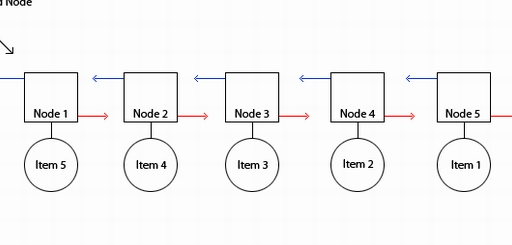
You’re given the pointer to the head node of a linked list. Change the next pointers of the nodes so that their order is reversed. The head pointer given may be null meaning that the initial list is empty.

Input Format
You have to complete the Node* Reverse(Node* head) method which takes one argument - the head of the linked list. You should NOT read any input from stdin/console.
Output Format
Change the next pointers of the nodes that their order is reversed and return the head of the reversed linked list. Do NOT print anything to stdout/console.
Sample Input
NULL
2 --> 3 --> NULL

Sample Output
NULL
3 --> 2 --> NULL
Node* Reverse(Node *head)
{
  // Complete this method
    struct Node* prev = NULL;
    struct Node* next = NULL;
    while(head!=NULL)
        {
        next = head->next;
        head->next=prev;
        prev=head;
        head=next;
    }
    head=prev;
    return head;
}

Note that this approach is not only specific to this type of question you can use this sorting technique in various questions such as if you want to check whether to word are anagrams of one another or not. You can simply sort them and compare them to find out. This approach is also helpful in other questions so i suggest that its better to learn this tricks and keep in mind while attempting the question you may find it useful. You can always search for more coding problems like this to get comfortable to this to approach or you can find new problems where this approach is applicable. So go and search more problems like this and check whether this approach is useful or not and you can tell me about it by commenting and writing about this to me.


Try more and more problems that you find on string and arrays and try to develop an approach the will help you understand problems rather then learning the solution. Once you know how to approach the problem you will able to solve any problem related to strings and array. I wish best of luck to you for your future.
Read More
  • Share This:  
  •  Facebook
  •  Twitter
  •  Google+
  •  Stumble
  •  Digg

Insert Node at nth position in a linked list

 Tech host     9:19 AM     cracking-the-coding-interview, interview-question, java, linklist-interview-question, linklist-question, popular-linklist-question     No comments   

linked list Interview Question

linked list

Insert Node at nth position in a linked list

insert-node-in-linked-list

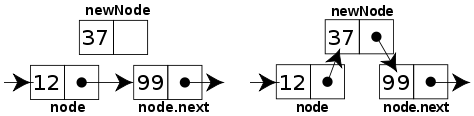
You’re given the pointer to the head node of a linked list, an integer to add to the list & the position at which the integer must be inserted. Create a new node with the given integer, insert this node at the desired position and return the head node. A position of zero indicates head, a position of 1 indicates one node away from the head and so on. The head pointer given may be null meaning that the initial list is empty.

Input Format

You have to complete the Node Insert(Node* head, int data, int position) method which takes three arguments the head of the linked list, the integer to insert and the position at which the integer must be inserted. You should NOT read any input from stdin/console. position will always be between 0 and the number of the elements in the list.

Output Format
Insert the new node at the desired position and return the head of the updated linked list. Do NOT print anything to stdout/console.
Sample Input
NULL, data = 3, position = 0
3 --> NULL, data = 4, position = 0
Sample Output

3 --> NULL
4 --> 3 --> NULL
Explanation
  1. we have an empty list and position 0. 3 becomes head.
  2. 4 is added to position 0, hence 4 becomes head.
Node* InsertNth(Node *head, int data, int position)
{
  // Complete this method only
  // Do not write main function. 
    struct Node* newnode = (struct Node*)malloc(sizeof(struct Node*));
    newnode->data=data;
    newnode->next=NULL;
    struct Node*  ptr = head; 
    if(ptr==NULL)
        {
        head = newnode;
        return head;
    }
    else if(position==0)
        {
        newnode->next=head;
        head=newnode;
        return head;
    }
    else
        {
        while(position>1)
        {   
            ptr=ptr->next;
            position--;
        }
        if(ptr->next==NULL)
        {
            ptr>next=newnode;
        }
        else
        {
            newnode>next=ptr->next;
            ptr->next=newnode;
        }
        return head;
    }
}

Note that this approach is not only specific to this type of question you can use this sorting technique in various questions such as if you want to check whether to word are anagrams of one another or not. You can simply sort them and compare them to find out. This approach is also helpful in other questions so i suggest that its better to learn this tricks and keep in mind while attempting the question you may find it useful. You can always search for more coding problems like this to get comfortable to this to approach or you can find new problems where this approach is applicable. So go and search more problems like this and check whether this approach is useful or not and you can tell me about it by commenting and writing about this to me.


Try more and more problems that you find on string and arrays and try to develop an approach the will help you understand problems rather then learning the solution. Once you know how to approach the problem you will able to solve any problem related to strings and array. I wish best of luck to you for your future.
Read More
  • Share This:  
  •  Facebook
  •  Twitter
  •  Google+
  •  Stumble
  •  Digg

linked list Interview Question

 Tech host     9:04 AM     cracking-the-coding-interview, frequently-asked-question, interview-question, java, linklist-interview-question, linklist-print-a-node, popular-linklist-question     No comments   

linked list Interview Question

Hey guys i am providing the solution to the most comman linked list question asked in interview as linked list is most important data structure from interview point of view.All these solutions are written by myself and checked for all the possible cases. Please take a look at them and help your self to solve your problems. If you have any query regarding the solutions or you want to ask something leave your comment and i will get back to you as soon as possible. Happy coding.


Question 1
Print the nodes of the given linked list?

Solution
click here to find the solution

Question 2
Insert the nodes at the given position in linked list?

Solution
click here to find the solution

Question 3
Find the intersection in a given linked list?

Solution
click here to find the solution

Question 4
Reverse a linked list?

Solution
click here to find the solution

Question 5
Compare two linked list

Solution
click here to find the solution
Read More
  • Share This:  
  •  Facebook
  •  Twitter
  •  Google+
  •  Stumble
  •  Digg

Array Left Rotation

 Tech host     8:34 AM     array, array-interview-question, array-left-rotation, frequently-asked-question, interview-question, java, left-rotation     No comments   

Array Interview Question

Hacker Rank Question

Array Left Rotation
left-rotation-of-an-array

Hey guys i am providing the solutions for the question given in the Chapter one Arrays and String of the very famous book Cracking the coding interview. All these solutions are written by myself and checked for all the possible cases. Please take a look at them and help your self to solve your problems. If you have any query regarding the solutions or you want to ask something leave your comment and i will get back to you as soon as possible. Happy coding.


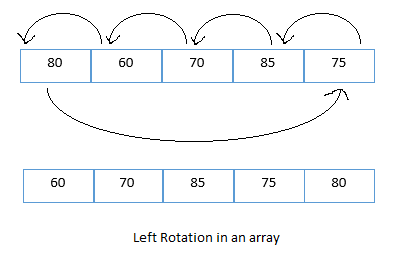
A left rotation operation on an array of size shifts each of the array's elements unit to the left. For example, if left rotations are performed on array , then the array would become .
Given an array of integers and a number, , perform left rotations on the array. Then print the updated array as a single line of space-separated integers.
Input Format
The first line contains two space-separated integers denoting the respective values of (the number of integers) and (the number of left rotations you must perform). The second line contains space-separated integers describing the respective elements of the array's initial state.
Constraints
Output Format
Print a single line of space-separated integers denoting the final state of the array after performing left rotations.
Sample Input
5 4
1 2 3 4 5
Sample Output
5 1 2 3 4
Explanation
When we perform left rotations, the array undergoes the following sequence of changes:
Thus, we print the array's final state as a single line of space-separated values, which is 5 1 2 3 4.
import java.io.*;
import java.util.*;

public class Solution {

    public static void main(String[] args) throws IOException{
        /* Enter your code here. Read input from STDIN. Print output to STDOUT. Your class should be named Solution. */
        BufferedReader br = new BufferedReader(new InputStreamReader(System.in));
        String as[]  =br.readLine().split("\\s");
        int n = Integer.parseInt(as[0]);
        int r = Integer.parseInt(as[1]);
        int c;
        String ele[] = br.readLine().split("\\s");
        ArrayList <Integer> arr = new ArrayList <Integer> ();
        for(int i=0;i<n;i++)
            {
             c = Integer.parseInt(ele[i]);
            arr.add(c);
        }
        for(int j=0;j<r;j++)
            {
             c = arr.remove(0);
            arr.add(c);
        }
        ListIterator <Integer> itr = null;
        itr  = arr.listIterator();
        while(itr.hasNext()){
       System.out.print(itr.next()+" ");
        }
    }
}
Note that this approach is not only specific to this type of question you can use this sorting technique in various questions such as if you want to check whether to word are anagrams of one another or not. You can simply sort them and compare them to find out. This approach is also helpful in other questions so i suggest that its better to learn this tricks and keep in mind while attempting the question you may find it useful. You can always search for more coding problems like this to get comfortable to this to approach or you can find new problems where this approach is applicable. So go and search more problems like this and check whether this approach is useful or not and you can tell me about it by commenting and writing about this to me.

Try more and more problems that you find on string and arrays and try to develop an approach the will help you understand problems rather then learning the solution. Once you know how to approach the problem you will able to solve any problem related to strings and array. I wish best of luck to you for your future.

Read More
  • Share This:  
  •  Facebook
  •  Twitter
  •  Google+
  •  Stumble
  •  Digg
Older Posts Home

Blog Archive

  • ▼  2017 (18)
    • ▼  August (2)
      • Dart replacing the node in the abstract syntax tree
      • Dart Programming
    • ►  March (10)
    • ►  February (6)
  • ►  2016 (1)
    • ►  December (1)
  • ►  2013 (1)
    • ►  August (1)

Popular Posts

  • Arrays-String interview question 2
    Cracking the coding interview Arrays and String solutions Hey guys i am providing the solutions for the question given in the Cha...
  • How to print the node of the given linked list
    Linklist Interview Question How to print the node of the given linked list If you're new to linked lists, this is a great ex...
  • Dart Programming
    Dart Programming Hey guys i am providing the solutions for the some of the problems that i have faced and worked on while exploring t...
  • Arrays-String interview question 8
    Cracking the coding interview Arrays and String solutions Hey guys i am providing the solutions for the question given in the C...
  • Arrays-String interview question 4
    Cracking the coding interview Arrays and String solutions Hey guys i am providing the solutions for the question given in the Ch...
  • Arrays-String interview question 3
    Cracking the coding interview Arrays and String solutions Hey guys i am providing the solutions for the question given in the Ch...
  • Arrays-String interview question 6
    Cracking the coding interview Arrays and String solutions Hey guys i am providing the solutions for the question given in the Ch...
  • Arrays-String interview question 1
    Cracking the coding interview Arrays and String question solutions Hey guys i am providing the solutions for the question given i...
  • Array Left Rotation
    Array Interview Question Hacker Rank Question Array Left Rotation Hey guys i am providing the solutions for the question given in...
  • Dart replacing the node in the abstract syntax tree
    Dart replacing the node in the abstract syntax tree Here is the solution for that. import 'package:analyzer/analyzer.dart'...

Categories

  • about-scra
  • abstract-syntax-tree
  • array
  • array-interview-question
  • array-left-rotation
  • compare-two-linked-list
  • cracking-the-coding-interview
  • dart
  • dart-analyzer
  • flutter
  • frequently-asked-question
  • google-flutter
  • interview-question
  • java
  • left-rotation
  • linklist-interview-question
  • linklist-print-a-node
  • linklist-question
  • popular-linklist-question
  • popular-string-question
  • scra
  • scra-2018
  • string
  • string-interview-question
  • string-palindrome-question

About Me

Tech host
I am a blogger interested in programming and coding challenges. I am interested in knowing about the new technologies and new tech products that are launched daily and to write about them.
View my complete profile

Label

  • about-scra
  • abstract-syntax-tree
  • array
  • array-interview-question
  • array-left-rotation
  • compare-two-linked-list
  • cracking-the-coding-interview
  • dart
  • dart-analyzer
  • flutter
  • frequently-asked-question
  • google-flutter
  • interview-question
  • java
  • left-rotation
  • linklist-interview-question
  • linklist-print-a-node
  • linklist-question
  • popular-linklist-question
  • popular-string-question
  • scra
  • scra-2018
  • string
  • string-interview-question
  • string-palindrome-question
Powered by Blogger.
Revoltify

Revoltify

Copyright © Data Structure and Dart Programming language problems | Powered by Blogger
Design by Hardeep Asrani | Blogger Theme by NewBloggerThemes.com | Distributed By Gooyaabi Templates